Making movement ≠ moving forward
Sep 12, 2026

What's your 20%?
The Pareto Principle, or the 80/20 rule, states that roughly 80% of results come from 20% of the causes.
When I look back on my life, I realize that this rule is surprisingly true. Many of the biggest things that have happened to me can be traced back to just a few decisions.
The biggest example that comes to mind is school. I spent an enormous amount of my life grinding—studying for exams, finishing assignments, trying to get good grades. But I'm not sure how much of that work actually changed my life. Sure, it probably made me more disciplined, but when I think about the outcomes I care about most, those countless nights of studying don't seem particularly significant.
And that makes me wonder, How should I use my time wisely?
But perhaps allocation is the wrong question.
I read The ONE Thing, a book that argues that extraordinary results come from narrowing your focus to a single priority. Looking back at my own life, that feels true.
When I was desperate to find a new grad job, I poured nearly all my energy into that one goal. I traded studying for interview prep and even risked failing a few midterms.
What's interesting isn't just that I got the job. It's how quickly everything happened. That period of intense focus lasted a little over a month. Afterward, I was mostly stress-free for the rest of the year. You could argue that my recruiting efforts had accumulated over previous years, but even then, the total amount of time I spent seriously recruiting probably wouldn't add up to a full year.
A relatively small period of my life produced an outsized result.
I moved to San Francisco just over a month ago and I ask myself what my 20% is almost every day. I feel like I'm doing a lot, but I haven't yet found the thing that creates that big-bang outcome. Sometimes I wonder whether the small things I'm doing consistently will eventually lead me there. Maybe they will. But I also know that making movement is not the same as moving forward.
There are plenty of people who work hard and stay busy without making meaningful progress. It's easy to get caught up in the whims and dramas of the world, but most of that is noise. The difficult part is learning to distinguish the signal from the noise, and recognizing which few things actually deserve our attention.
I'm guilty of confusing the two myself. I often feel like I need to be productive every minute I'm awake. But organizing my downloads folder or prompting an agent with a question I already know the answer to isn't progress. They might make me feel productive, but they aren't going to change the trajectory of my life. Even now, as I write this, I wonder if it means anything in the grand scheme of things.
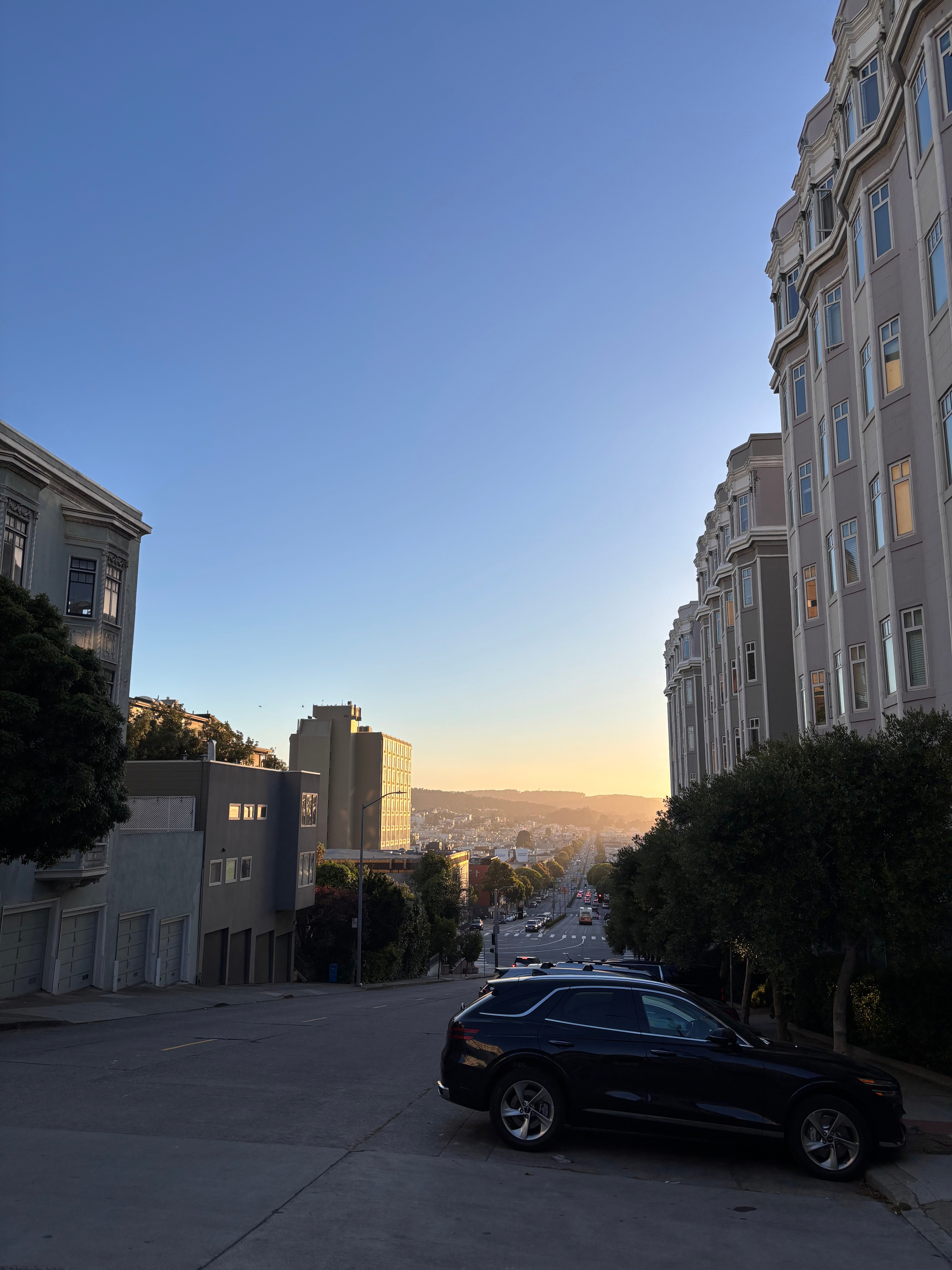
Moving countries, coming to San Francisco, and starting my first full-time job felt different. It was one of those moments where I could feel my life moving forward.
I want more moments like that.
These days, I have the dangerous thought that perhaps what I'm looking for isn't on the path that I'm treading. And it makes sense. There are many people on a path similar to mine, even though we might have significantly different pasts. And it seems to me right now that those who have had their 20% moments made a different choice somewhere along the way—and are now living different lives.
I find that possibility rather unsettling, but I think it's a healthy thought to have. I also wouldn't argue that I made the wrong choices. I'm confident that I did my best under the circumstances I was in, and I wouldn't change them even if I had a time machine.
But this thought changes how I look at my future and the direction I'm going in. Our paths are unique to us, and they aren't fixed. The remaining question is how I plan to bend mine.
Coming back to the present, I realize that it's time for me to evaluate again. It's one of those moments when, after achieving a milestone, the dust settles and you have to look around to see where you are.